October is Photographer Appreciation month. A great time to think about photography and why it’s important to us.
As many of you know, my dad was a photographer in the Royal Navy from 1948-1960. He joined when he was 18 and had met my mum by the time he left. One of the most precious things we did during lockdown was put together a book of his memories from that time. It was a joint venture – dad wrote it all down, my mum typed it, my oldest son proof-read it and I put it all together in a book with his photos. So, I wanted to share some of my favourite stories with you here, as part of Photographer Appreciation Month.

Photographic training
On the 30thOctober 1948 I was drafted to HMS Blackcap, RNAS Stretton, Near Warrington for Naval Airmanship training. We went through all aspects of the Branch, which were aircraft handling; theory of flight; theory of 4 stroke engine; safety equipment and meteorology but not photography. By a miracle I passed out top. We had to see the course officer to choose which part of the Branch we wanted to be in. I said I wanted air mechanic airframes, he replied as I was top of the course, I had to be a photographer or meteorologist. I chose photography and air mechanic airframes as a second choice.

Developing an X-ray photograph
In April, we left the Persian Gulf. During this time, at 0200 my hammock was shaken and I was told to go to the sick bay. When I arrived, I saw a rating laid on the deck and an X-ray being used; I was asked to develop the film. Well, I had never developed an X-ray and did not have the correct developing chemical but I did know that X-rays should have good contrast and be as sharp as possible.
So out went the normal MQ developer, in went a caustic tablet and I crossed my fingers. When the X-ray film dried it looked ok to me, so I was off back to the sick bay. The doctor took one look and said it was constricted intestines. Right away I was off to the next RAF air strip shown on our chart. I signalled to them and they replied that the airstrip was out of use. I reversed course and headed at full speed (16 knots) to the new destination. Here there was an ambulance and an aircraft scheduled to take the patient to Aden.
Crossing the Equator
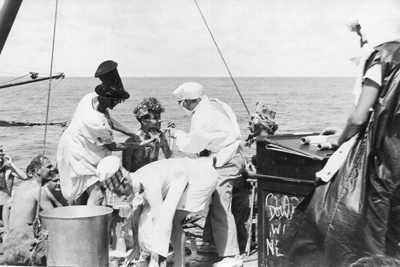
Off to Zanzibar, we crossed the Equator with all the ceremonies of Neptune and his wife’s visit. Those who had not been across the line before (which included myself) were shaved with a large wooden razor, accompanied tales told to take the mick. After the shaving, still sitting in the barber’s chair, we were tipped backward into a tank of water and ducked under. This was not an optional experience.
Printing a life sized photograph
We were required to make a print that was nearly life sized. Luckily we had a horizontal enlarger so could project the image onto the darkroom wall and a large roll of paper had to be used to print on. First of all, small strips of the paper were pinned to the wall at selected spots, to ascertain the correct exposure and shading required. The biggest problem we had was that when anyone moved anywhere in the building it was possible that the wooden building would shake. The exposure was quite long and any movement would make it blurry. We started making the print, I was doing the shading and it was going well, no building movement. Suddenly the telephone started ringing and CPO Punch-Wolf ran down the passage and the whole building bounced up and down. So, we ripped down the paper, replaced it and started all over again!
I hope you’ve enjoyed reading some of my dad’s memories from his days in the Navy. I love hearing all about the old cameras he used and the chemicals he had to mix himself, it really makes me appreciate my digital camera, laptop and studio in Tonbridge! As it’s Photographer Appreciation Month, I’d love to hear who your favourite photographer is. Let’s start a conversation.
Leave a Reply
You must be logged in to post a comment.